How Many Discs in Reversi? Board Size and Basic Rules
Published Updated
Conclusion: The board is 8 squares by 8 squares = 64 squares, and when completely filled there are exactly 64 discs. Excluding the initial 4 discs placed in the center, the maximum number of moves that can be played in a game is 60 moves.

When approaching the board for the first time, you might wonder how many discs are used to play Reversi or Othello. Understanding basics such as the board size and the number of discs helps you follow the flow of the match with calm confidence.
| Item | Details |
|---|---|
| Board size | 8 rows by 8 columns (total 64 squares) |
| Total discs | Maximum 64 discs on the board (4 in starting position + up to 60 moves) |
| Initial layout | Place 2 black and 2 white discs diagonally alternating in the center |
| Win/loss condition | The player with the majority of discs wins when the board is full or neither can play |
| Try in the app | Computer matches in Legends |
How Many Squares on the Board? Squares and Disc Totals
A Reversi board has 8 squares by 8 squares, making 64 squares in total. Vertical columns are labeled a–h and horizontal rows 1–8, with square positions identified by column and row combinations like "d4".
The number of discs in Othello (Reversi) corresponds to the 64 squares on the board, meaning there are exactly 64 discs on the board once all squares are filled. Black and white discs are placed alternately, outflanking the opponent's discs and flipping them to your color.
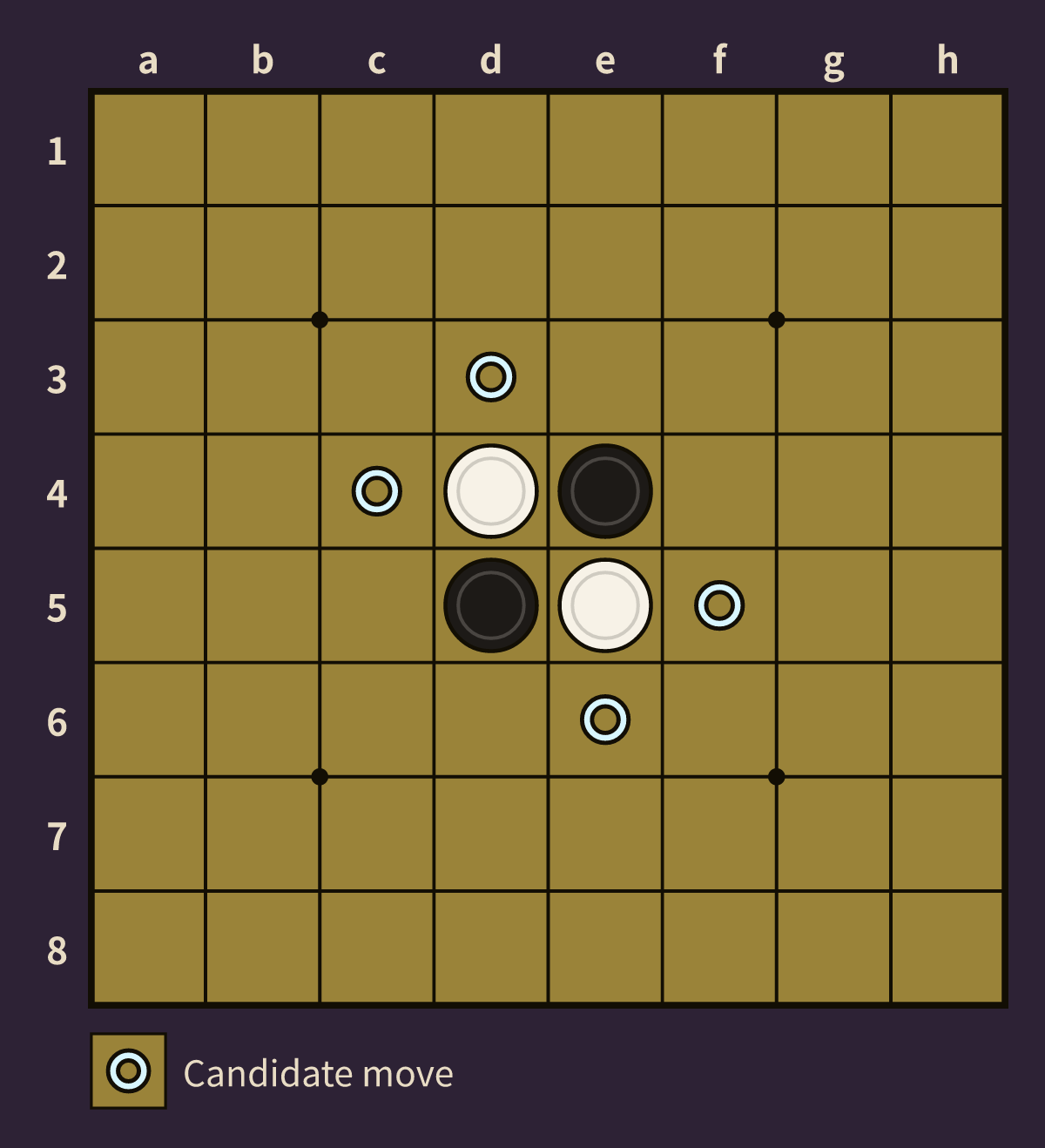
Figure 1 as text
Black discs (2): e4 d5
White discs (2): d4 e5
To move: Black
Candidate moves: c4 d3 e6 f5
Board (from rank 1): ......../......../......../...WB.../...BW.../......../......../........
This diagram shows the starting position at the beginning of a game. White is placed at d4 and e5, Black at d5 and e4, leaving exactly 60 empty squares. Black takes the first move, and the playable squares are restricted to the 4 marked locations: c4, d3, e6, and f5.
How to Outflank and Prevent Your Opponent from Taking
Placing a disc is the sequence of picking an empty square that outflanks the opponent's discs with your own and flipping all outflanked discs to your color. You cannot place a disc where it does not outflank anything; if there are no playable squares on your turn, you must pass.
- On your turn, look for an empty square that outflanks the opponent's discs horizontally, vertically, or diagonally.
- Place 1 disc of your color on the chosen square and flip all opponent discs outflanked along straight lines.
- Turn passes to your opponent, and both players alternate making 1 move each.
Figure 2 as text
Black discs (4): e4 d5 e5 f5
White discs (1): d4
To move: White
Last move: f5
Board (from rank 1): ......../......../......../...WB.../...BBB../......../......../........
This diagram shows the position right after Black plays f5. White can play on 3 squares: d6, f4, or f6, flipping 1 black disc at d5 for d6, e4 for f4, or e5 for f6. To avoid having many discs flipped by your opponent, refrain from greedily spreading discs toward the outer edges during the opening phase. Flipping only interior discs restricts the squares your opponent can play on next turn.
Try out this procedure in offline computer matches in Legends. Small dots show where you can play so you can spot outflanking squares at a glance, and opponent strength is divided into 5 tiers from Apprentice to Matchless.
Play in the app
Small dots mark playable spots, so you can play your very first game while learning the rules!


Scan with your phone to open the store
Strategic Differences Between Opening and Endgame
Disc strategy depending on game progression means keeping your disc count low in the opening phase and rapidly increasing it toward the endgame to aim for victory. Increasing your discs too much on the board during the opening gives your opponent more outflanking footholds, which in turn reduces your own mobility.
Figure 3 as text
Black discs (5): c4 d4 e4 e5 f5
White discs (2): d5 d6
To move: White
Last move: c4
Board (from rank 1): ......../......../......../..BBB.../...WBB../...W..../......../........
This diagram shows the position after Black plays c4. White can then play on 5 squares: b3, d3, f3, f4, and g5. In the opening phase, rather than focusing on disc count alone, it is vital to select moves by counting how many squares your opponent can play on next.
| Phase | Target disc count | Goal and points of attention |
|---|---|---|
| Opening phase (moves 1–20) | Keep it low | Deny opponent moves and gather discs near the center |
| Midgame (moves 21–40) | Do not increase unnecessarily | Keep the wall intact and establish footholds to take a corner |
| Endgame (moves 41–60) | Maximize rapidly | Increase discs from secured squares that cannot be outflanked to win |
Good and Bad Examples for Beginners to Keep in Mind

Decisions that favor your match consist of securing corner squares that can never be flipped and avoiding risky squares that let the opponent capture a corner. Discs placed on the 4 corners at a1, h1, a8, and h8 can never be outflanked by the opponent through the end of the game. Corner capture is detailed in How to Take Corners in Othello and Reversi, passes and counting in Passes and Draws in Othello and Reversi, and first steps in How to Play Othello and Reversi.
| Situation | Successful approach | Common mistake |
|---|---|---|
| Capturing in opening phase | Quietly flip only 1 or 2 discs and stay inside | Loudly take 4 or more discs early, expanding outward |
| Near corners | Carefully play away from the corner to avoid conceding it | Inadvertently play diagonally adjacent to a corner, losing it |
| Square selection | Choose moves that reduce the opponent's options | Get distracted solely by squares that maximize your discs |
Frequently asked questions
How many discs do you need to play Othello to completion?
You can play a full match with at most 64 discs. The board is an 8x8 grid of 64 squares, and exactly 64 discs are used when all squares are filled.
What happens to the disc count if someone passes mid-game?
Since no disc is placed, the count on the board does not increase. A player who has no legal outflanking moves passes their turn, and the opponent places a disc consecutively.
Why does taking many discs in the opening phase often lead to defeat?
Because it increases the squares where your opponent can play. Taking too many discs in the opening exposes your color on the outside, offering the opponent many footholds to outflank your discs.
How can I practice placing discs in Legends?
We recommend using computer matches in Legends. There is an assist feature showing small dots on playable squares, allowing you to practice progressively starting from Apprentice.
Play in the app
Tour Edo's famous sights and face fifty opponents in Reversi: Legends of Edo. The computer thinks right on your device, so you can finish your games against it on a plane or on the road.
Scan with your phone to open the store