Reversi History and Lore: Genpei-go and an Edo Board Journey
Published

Do you ever wish to step away from daily bustle and enjoy an intellectual board pastime immersed in quiet Japanese charm? Outflanking and flipping black and white round discs has become widely popular today, yet exploring Reversi history, origins, and ties to the ancient game known as Genpei-go evokes deep cultural atmosphere.
This article warmly reflects on old Edo landscapes, the charm of outflanking black and white discs, and key principles beginners can easily enjoy.
Atmosphere and Lore Woven by Black and White on the Board
The origins of capturing discs by flanking and turning them to one's own color remain open to various theories, impossible to link strictly to a specific person or era. In Japan, traditions hold that past players enjoyed board diversions like "Genpei-go," where 2 colors faced off across the grid.
The name "Genpei-go" is often explained as referencing the white banners of the Minamoto clan and the red banners of the Taira clan. Modern Reversi discs are black and white, but the back-and-forth contest of trading colors suits a calm moment with a partner. Beyond hunting down exact historical records, the true lasting appeal lies in sharing breath and rhythm across the board.
Modern Reversi uses an 8×8 board with clear rules: black and white alternate, flipping outflanked opponent discs. The game concludes when the board fills or neither player has a valid move, with the most discs winning. Despite such simplicity, every single disc can completely transform the board landscape.
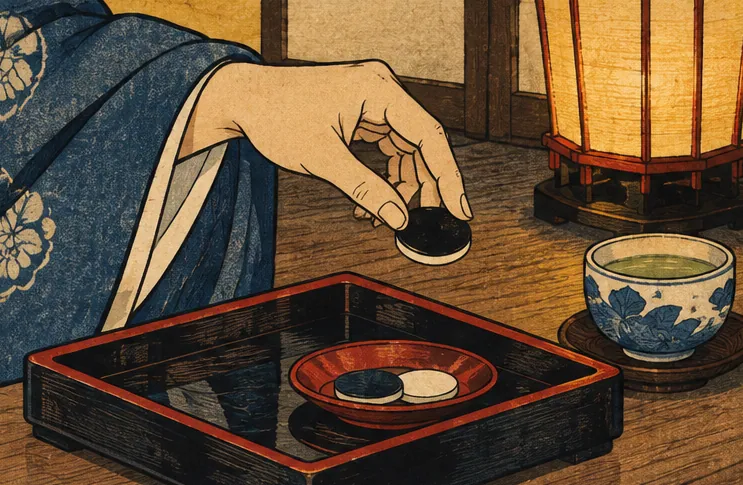
Strolling the Board as if Visiting Edo's Famous Sights
The 8×8 grid on the board feels like a journey through Edo streets. Setting out from busy Nihonbashi, passing the theater district of Asakusa Saruwakacho, crossing breeze-swept Ryogoku, Fukagawa's waterways, and Shinagawa's shore gazing at foreign vessels before reaching Edo Castle makes every move richer.
Just as a journey brings encounters with diverse townsfolk, facing opponents with different personalities across the board is a joy. In the smartphone app 『Legends』, you can travel among these famous landmarks while challenging 50 opponents of varying skill.
| Rank | Opponent Style | Mindset |
|---|---|---|
| Apprentice | Does not yet grasp corner value | Calmly test basic outflanking |
| Skilled | Seeks corners, exploits openings | Play carefully to reduce blunders |
| Master | Counts mobility before moving | Avoid taking too many discs early |
| Edo Champion | Reads endgame sequences completely | Build an advantage in the midgame |
| Peerless | Flawless; yields neither corner nor edge | Stay fully focused without relaxing |
Adapting your play to each opponent's style echoes the delight of discovering unfamiliar landscapes and people on a journey.
Play in the app
Small dots mark playable squares, letting you play your first game while learning the rules.


Core Principles for Beginners and Play Rooted in Daily Life
Beginners or returning players often wonder where to place a disc. Knowing a few straightforward guidelines will help you survey the board with confidence.
- Value the four corners: Once placed, corner discs can never be flipped, serving as dependable strongholds.
- Do not take too many discs early: Gaining too many discs early gives your rival more outflanking options and diminishes your own available moves.
- Limit opponent options: Preserve your own moves while steering the board toward shapes that restrict your opponent.
Because the basic guidelines are so straightforward, outflanking and flipping discs spread as an easy parlor game for family and friends wherever a board was found. Over generations of play, common opening patterns earned animal names like Rabbit, Tiger, and Cow. While the exact origins of these names remain unrecorded, the affectionate naming of board shapes reflects how warmly people embraced the pastime in everyday life.
Enjoying a Solo Match in Offline Quiet

When stepping away from busy routines and phone notifications to catch your breath, board play makes an ideal companion. In the journey of 『Legends』, the computer opponent thinks locally on your device, letting you play all 50 rivals without any network connection.
Playable squares display small guide markers, enabling beginners to make their first move without hesitation. In addition, a skill check estimates your strength after just 1 match to suggest well-matched opponents, while game transcript playback allows you to review finished games 1 move at a time.
Opponents along the journey from Nihonbashi to Edo Castle unlock naturally as you advance through the story, with no extra purchases required. Why not enjoy quiet moments akin to playing beneath an oil lamp during your commute or travels?
Frequently asked questions
Is the origin of Reversi identical to Genpei-go?
Origins cannot be tied to specific games or eras. Traditions simply tell of pastimes like Genpei-go where 2 colors outflanked one another.
Can beginners play smoothly from the opening phase?
Small guide markers show where you can move. Even without knowing all the rules beforehand, you can enjoy your first move with ease.
Can I play alone in places without cell service?
The computer thinks right on your device, allowing full offline play. You can comfortably finish matches while traveling or in quiet spots.
Does expanding opponents require extra purchases?
No extra payment is needed; opponents unlock as you travel through Edo. Simply advancing the story unlocks all 50 opponents naturally.
Play in the app
Tour Edo landmarks and face 50 players in the Reversi app 『Legends』. AI computes on your device, allowing full play without network coverage.